“I see the good in everyone,” claimed the meme. A recent photo showed a woman and man locked in a stare. The article quoted her as saying she wanted him to acknowledge her humanity. Even without the context it is obvious the white man is angry and shouting in the face of a black woman, head and shoulders shorter than he, yet standing face to face in silence while he spewed his hatred. It is hard to see the good in him, in this demeaning act of vicious speech and spit. With no context one might wonder what she did to receive such wrath. Where is the “good” in this still-life moment captured for eternity?
So God created humankind in his image,
in the image of God he created them;
male and female he created them.
God blessed them...
Gen 1: 27-28a
I read about Ahmaud Arbery before his story, his death, hit the national news; and, it silenced and paralyzed me in shame and sorrow. I had no idea we would hear of two more murders within weeks, and see the riots and protests that erupted, of which the woman above was a part.
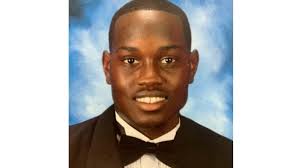
But I am stuck on that meme, “I see the good in everyone,” because it is hard to see the good in the man who hunted Ahmaud Arbery down, cornered him, acted as judge and jury and executioner with no evidence, with personal bias, with centuries of racist teaching, and racial privilege to boot. What would it mean to affirm his goodness, walking casually away from the body riddled with bulletholes?
The God I serve proclaims,
“…I will forgive their iniquity, and remember their sin no more.” (Jeremiah 31: 34)
Who would do such for someone who has no good in them? No one. Most of us don’t want to serve, much less worship any god who fails to do justice, who says effectively, “I see the good in everyone.”
We strive to see the good in those whose evil is splashed across our computer screen and social media pages for one reason. We actually know our own capacity for unspeakable evil as well as untold goodness. But that evil must be hidden, covered, with “there’s some good in there, I’m — he — can’t be all bad,” so that we can protect ourselves from being found out.
“I see the good in everyone,” may also become, “I’m not like that.” We protect by distancing ourselves from the evil we know lurks under our skin waiting for the opportune moment to shockingly erupt into our world and shame us, strip us naked in front of everyone.
Human beings are complicated. I suspect the shouting man’s mother sees good in him. The shooter’s mother sees the good in her son. I have seen Arbery’s mother describe the good in him. Mothers know. We know the good, and, oh, we know the bad. We stare into our children’s eyes and love them whole.
It is not the good we are meant to see so much as their, and our own, humanity. Like a woman staring down her attacker, waiting for him to acknowledge her humanity. Her action, she herself, like a holy mother, embodies what she asks of us. She acknowledges his humanity and waits, without ugliness, for him to see himself reflected in her eyes. If he looked, he would see the good, the bad, the beauty and the ugliness, full of witnessed curses and full of hidden blessing. If only he can see the humanity in her as she is willing him to see his own.
God blessed them...
God saw everything that he had made, and indeed,
it was very good.
Gen 1:31
He might see the gift of grace that has the power to remove the iniquity of his racist behavior as far away as the east is from the west. That is the hope of an incarnate diety, who came to walk with us on The Way, that we might look upon one another, eye to eye, and see our humanity, our blessed, messy, humanity, which bears the image of our creator.
The challenge on The Way is to treat perpetrators of evil as if they, too, are human beings bearing God’s image. By their own evil action they have shattered that image, broken community, traded the good for the evil. Seeing Arbery’s shooter in this light allows justice to prevail. Without the recognition of the human being, the society can simply shoot him like a dog in the street whose rabid act deserves to die. His terroristic act must not be met with the same. His humanity, his innate goodness demands Ahmaud Arbery’s shooter to be held accountable, and make penal restitution for the evil he perpetrated upon Arbery, his family, and the whole society. There must be justice for all.
Because what is not acknowledged as sin, cannot be forgiven. What is not forgiven can never be put out of mind. What cannot be forgotten will forever retain its power.
If the goal of justice is more than punishment, if this justice means eradicating racism, that goal requires, not eye-for-an-eye, but rather, an eye to eye acknowledgment of our common humanity. His name is Travis and he deserves the full weight of justice be brought upon his work. And upon all who operate within the evil of racism to do harm, to murder, to dehumanize–justice, for all. No more. But certainly no less. Our humanity demands it. Because right now, we need to demonstrate clearly that justice for all means black lives matter.

 bevfriedlander