Grace and peace!
To my siblings in Christ who seek to unseat the current President in the upcoming election: You have been a welcome partner in ministry for some time; and, to know I am not alone is to know the power of the bond of Christ reaching across the layers of difference we have created and which the Holy Spirit transverses nonetheless.

To you I write about love. Love.
That word is cast around as easily as the basket of warm yeast rolls everyone is drooling over tasting. “I love this restaurant,” “I love these shoes,” “I love that movie.” We use the word so incautiously that when a true love up and dies, we are overwhelmed with grief.
Today, many preachers are nearly as incautious (myself included) with the word and the use of the phrase, “Love your neighbor.” We (yes, you can read that, I,) offer it as a way to entice our hearers to volunteer, to attend a bible study with a neighboring church or at the coffeehouse, or to become less prejudiced, or more generous, or to wake up to white supremacy, or as a question to ask of our politics that we might vote our faith.

“Love your neighbor,” is as routine an invitation in our sermons and prayers as is the request for forgiveness and absolution we offer in Christ’s name. That ubiquitous claim has led to a numbness, the death of love that transforms the doubters, the nones, and the dones. You know our evangelistic fervor left in favor of social action. Not a terrible trade-off, but an exchange nonetheless.
I do not give up hope that love is more than wearing a mask, social justice, and mission outreach. It is one of the two great commandments Jesus identifies as the foundation for any and all of the rules of life found in Scripture, and in his own modelling of godliness.
I admit I don’t often reference the other love Jesus put before us; but, it is the love to which we must turn to reclaim our own nature and to return to the way of Christ. That love is the pentecostal power that will transform us and display the radical hospitality we like to proclaim. That love shone in the lives of the apostles as they evangelize the world. It was prominent in Paul’s teaching and his transformed, born-again life of spreading the gospel of Christ.
Jesus defined this love with absolute clarity, in deed and word. Jesus is what love looks like. And thus, his command is also autobiographical.
“You have heard it said, ‘love your neighbor,’ but I say, love your enemy and pray for them.” (Mt 5: 43-48)
Jesus is explicit—love and pray FOR them, not about them.
I’m guilty. With any number of prayers over my lifetime, regarding my perceived enemies, I have reassured myself that my antipathy is biblical, as though mouthing the words, “if vengeance is yours, o, God, then show no mercy,” can somehow be a loving my enemy kind of prayer.
A simple, and impossible shift in attitude is commanded and a postural turning, a repentance, demanded by Jesus. “Though vengeance is yours, and our desire, o, God, show them your mercy.” How hard it is to pray earnestly for mercy upon someone who has been merciless. This week, as Donald J. Trump battles the coronavirus within, we, my beloved siblings, have the opportunity to be as public in our ability to love our enemy and pray for him as we have been public about disdain for his evil ways and prayed against him.(If any are reading this letter who would challenge that perception of Trump’s lack of mercy, know that children sleeping in chain link cages on concrete warehouse floors is merciless.)
Church, this is our call: to love and pray for the president. The way of Christ commands us to come together in love for all our enemies, and especially those whose names and countenance we know. The God who became one of us for us and our salvation also became incarnate and life-giving for these enemies.
He, and all our enemies who traffic in inhumane policies and procedures, need our prayers more than our friends. They need God’s irresistable outpouring of grace and a transformative Damascus road, blinded by the light kind of Christ encounter, more than our friends. We, who see their lack of mercy, their injustice, their inhumanity toward others, are meant to reflect the nature of our God whose image we see in Christ, and which we share.
The disciples experienced the love-your-neighbor posture regularly in their travels with Jesus. But there was a crucible time when they truly experienced the stance of love-your-enemies. It began at their last meal when they watched their brother Judas leave only to return with Roman soldiers and betray Jesus with a kiss. Within hours they heard the last words of a dying Jesus pray for forgiveness for those who executed him on the cross. We have claimed this moment as the greatest act of love and a prayer offered on behalf of all of us, all of us enemies of God.
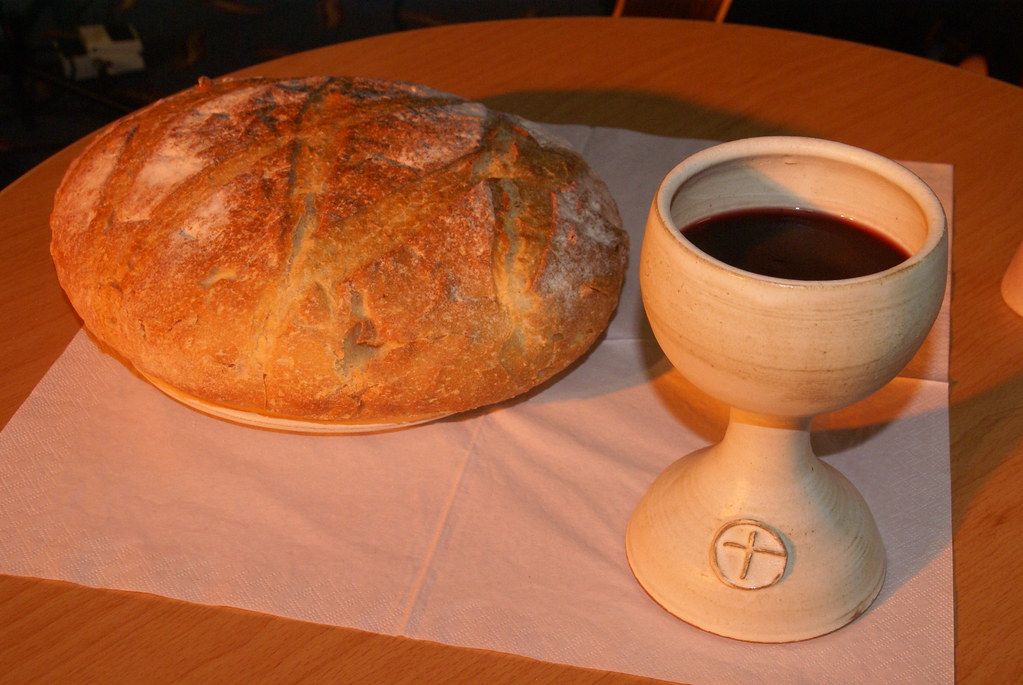
In days to come, beloved, we shall sit at the table and pass the bread that we love to those we love. May we not be known to others by the name, “Judas.” Let us love our enemies, and pray for them, for “whatever you do to the least of these, my siblings, you have done unto Christ Jesus.” (paraphrase, Mt 25: 40)
Therefore, let us lovewith the love of Christ and pray for Trump. God knows he needs it.

 bevfriedlander